All Categories
Featured

How API Automation Simplifies Site & Page Builder
Table of Contents
The Shift Toward Data-Centric Browse Architectures in 2026
The year 2026 has redefined the essential mechanics of how big organizations handle their digital existence. In previous years, search exposure relied heavily on manual content creation and reactionary technical repairs. Today, the focus has moved toward a more integrated design where data integrity and machine-readability determine success. Massive business no longer deal with search as a marketing layer added after the truth. Instead, search-first logic is embedded directly into the preliminary software application develops and product deployments.
Technical groups have actually increasingly prioritized the health of their internal information structures over shallow keyword density. Online search engine in 2026 have actually ended up being extremely effective at identifying semantic relationships in between entities, making the old technique of "enhancing" private pages nearly outdated. Organizations now concentrate on building a cohesive understanding chart that search bots can absorb in a single pass. This motion towards entity-based optimization guarantees that details remains constant throughout various search user interfaces, including conventional internet browsers, voice assistants, and augmented reality overlays.
Success in this environment requires a deep understanding of Site & Page Builder. When these systems are developed properly, they provide a steady foundation for hundreds of countless private URLs. The focus on Managed SEO Hosting reflects a broader industry trend where accuracy and technical precision take precedence over sheer volume of content. This shift has actually forced a reorganization of numerous internal teams, moving search experts out of the marketing silo and into the engineering and information science departments.
Algorithmic Interpretation and Neural Indexing
By 2026, the method online search engine process info has actually moved entirely to neural indexing. This suggests that bots are not simply searching for matches in text; they are replicating how a human may view the worth and intent behind a page. Speed stays an important element, however the definition of efficiency has actually changed. It is no longer just about how quick a page loads, but how quickly the main response can be extracted by an expert system model for usage in a zero-click outcome.
Infrastructure expenses have risen for business that fail to maintain tidy codebases. Online search engine have actually restricted "computation spending plans" for each site, and if a server takes too long to render a complex JavaScript application, the bot simply moves on. This has caused the prevalent adoption of edge-side rendering, where content is pre-compiled at the network level to make sure near-instant delivery. Handling these international releases has actually ended up being a specific field, and Secure Managed SEO Hosting Solutions has actually become the requirement for preserving presence in extremely competitive markets.
Information quality is now the main differentiator. If a company releases clashing details about an item cost or a service availability, search engines may lower the trust score of the entire domain. Technical supervisors are using 2026 to implement rigorous recognition protocols that avoid structured data mistakes before they ever reach the live environment. This proactive position lowers the danger of being left out from the generative search engine result that now dominate the top of the search engine results pages.
The Role of Generative Search in International Markets
Generative search experiences (GSE) have actually grown considerably in 2026. These systems do not just offer a list of links; they manufacture a response based on the most authoritative sources available. For an enterprise to be included in these summaries, their content should satisfy a really high threshold of accurate accuracy and structural clearness. This environment has made standard SEO tactics, such as link-building plans or keyword stuffing, entirely inadequate.
Modern methods focus on providing "uniquely useful" information that can not be discovered somewhere else. This might include exclusive research, real-time pricing feeds, or interactive tools that resolve particular user issues. Due to the fact that GSE models prefer authoritative voices, lots of firms are buying deeper combinations with Site & Page Builder to guarantee their data is the source of reality for these AI-driven answers. The objective is to end up being the "favored entity" within a particular niche, ensuring the trademark name is cited as the primary source in the generated summary.
This has changed the nature of competition. Rather of defending the first position in a list of ten links, companies are combating to be the information company for a single, comprehensive answer. This requires a level of technical sophistication that was uncommon simply a few years back. Organizations are now employing data designers to map out their details hierarchy, making sure every piece of material serves a particular purpose within the larger digital method.

Scalable Content Governance and Quality Control
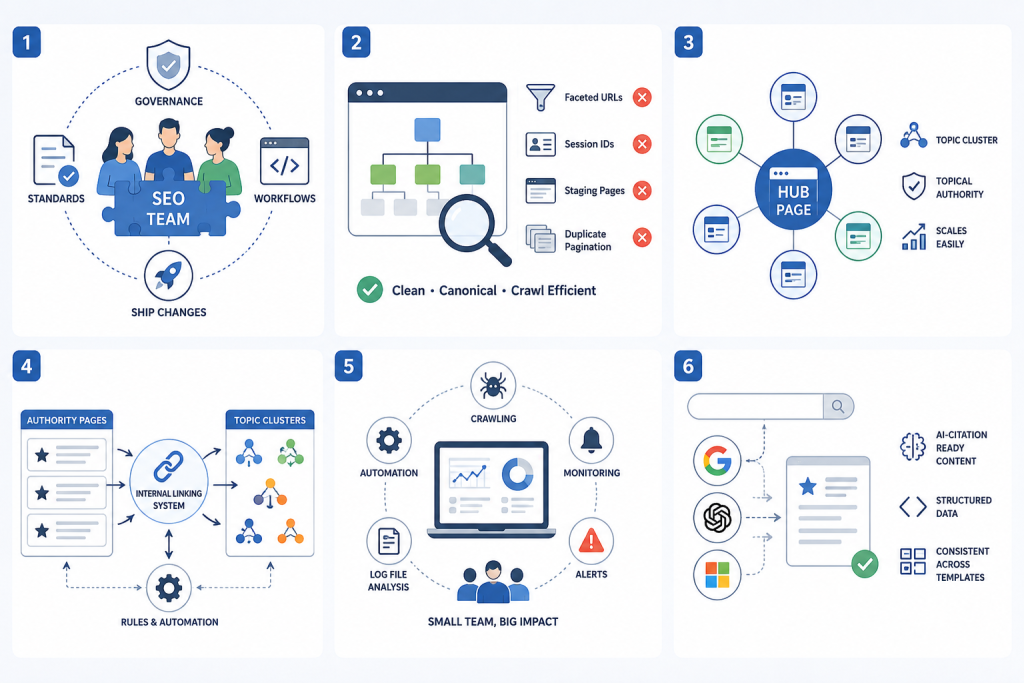
Handling material at a business scale in 2026 requires more than just a large group of authors. It requires an automated governance system that can audit millions of pages for accuracy and tone. These systems utilize natural language processing to determine outdated info, broken links, or material that no longer lines up with the brand name's know-how. In an age where online search engine punish thin or repeated material, maintaining high standards across a huge site is a considerable operational hurdle.
Large corporations often search for Managed SEO Hosting in 2026 to assist them navigate these complex requirements. These partnerships typically focus on producing "self-healing" websites that can spot and fix typical technical mistakes without manual intervention. If a product goes out of stock, the system automatically updates the schema to show this, avoiding search engines from sending out traffic to a dead end. This level of automation is no longer a luxury but a need for services that wish to maintain their market share in 2026.
The human element has not disappeared, however it has altered. Material developers in 2026 invest less time composing basic descriptions and more time on top-level technique and original reporting. They work together with AI tools to create drafts, but the last output is greatly scrutinized for original insight and competence. This "E-E-A-T" (Experience, Proficiency, Authoritativeness, Dependability) focus is more intense than ever, as online search engine have progressed at finding generic AI-generated fluff that does not have real-world worth.
Combination of Search and User Experience Design
In 2026, the line in between search optimization and user experience has actually blurred to the point of vanishing. Browse engines now utilize behavioral signals-- such as how long a user connects with a page or whether they discover the response they were looking for-- as direct ranking aspects. If a page ranks well however stops working to satisfy the user's intent, its exposure will drop quickly. This real-time feedback loop has forced designers and search professionals to work more closely together.
User intent is no longer a basic binary of "informational" or "transactional." In 2026, search engines acknowledge hundreds of subtle variations in intent, from "casual exploration" to "urgent problem-solving." Sites should be flexible adequate to present various layouts or content types based on these predicted requirements. A user searching for a fast technical specification should not be forced to scroll through 2,000 words of initial text. Modern architectures utilize Site & Page Builder to dynamically adjust the discussion of info based on the incoming search query.
This level of personalization requires a robust backend that can deal with countless different page variations without compromising speed. Edge computing plays a massive function here, allowing the website to "assemble" the perfect page variation in a millisecond at a server location closest to the user. This lowers latency and ensures a smooth experience, which online search engine reward with higher exposure. The focus is always on minimizing the "time to worth" for the visitor.
Future-Proofing Through Knowledge Graphs
The most effective business in 2026 are those that have developed their own internal understanding graphs. These are structured databases that define the relationships between their products, services, staff members, and places. By releasing this information in a format that browse engines can quickly import, these companies successfully "determine" how they are perceived by the algorithm. They move from being a collection of keywords to being a recognized entity with specific qualities and track records.
Building this structure is a long-term job that requires cooperation across the entire organization. It involves cleaning up legacy information, standardizing calling conventions, and making sure that every department utilizes the exact same "source of reality" for information. While the preliminary financial investment is high, the payoff is a resilient digital existence that is less susceptible to the impulses of algorithm updates. When a search engine comprehends precisely who a business is and what they do, it is much more likely to show them to the ideal users.
In the closing months of 2026, the pattern is moving toward "predictive search." Online search engine are beginning to expect what a user may need before they even type an inquiry, based upon their previous behavior and existing context. Enterprises that have their technical house in order will be the ones that appear in these predictive tips. This requires a level of information preparedness that was unthinkable a years earlier, but in the present market, it is just the cost of working at scale.
Technical search management has actually moved far beyond the days of meta tags and backlinks. It is now a discipline of information engineering, systems architecture, and user psychology. Those who master the intricacies of these 2026 environments will discover themselves with a considerable competitive benefit, while those who cling to old-fashioned approaches will discover it significantly challenging to stay noticeable in an AI-dominated world. The focus remains on clearness, speed, and the shipment of authentic value to the end user.

Latest Posts

Navigating a Harsh 2026 SEO Environment
Essential PBN Management Tools for High Scale
Acquiring High-Authority Backlinks at Scale